

Oil Reserves In Southwest Asia
A HUMAN PERSPECTIVE On October ii, 1995, Queen Noor of the Kingdom of Jordan gave a speech on the function of women in Southwest Asian economies. In her speech communication, she identified an important change in the economies of Southwest Asia: The changing environs in our region holds the promise of new opportunity for businessmen and women. Middle Eastern women are overcoming discriminatory socio-cultural constraints [limitations] that in one case denied them equal access to services and hindered [slowed] their participation in the economy.
Queen Noor described ane of the ways in which countries in the region are using the skills of their people to change the economy. Today, money earned from the region's virtually of import export—oil—is helping to build a more diverse economic system.
Meeting the Global Demand
At the start of the 21st century, oil fueled the world's industries and transportation—and its economies. This "blackness gold" was so vital that oil became a strategic article, a resource so important that nations will go to state of war to ensure its steady supply. Southwest Asia contains much of the oil supply.
Every bit you learned in Chapter 21, about 64 percent of the world'south proven oil deposits and 34 percentage of its reserves of natural gas are found in this region. By the twelvemonth 2020, exports from Southwest asia will probably provide most 44.v million barrels of oil per mean solar day, or about 50 percent of world demand.
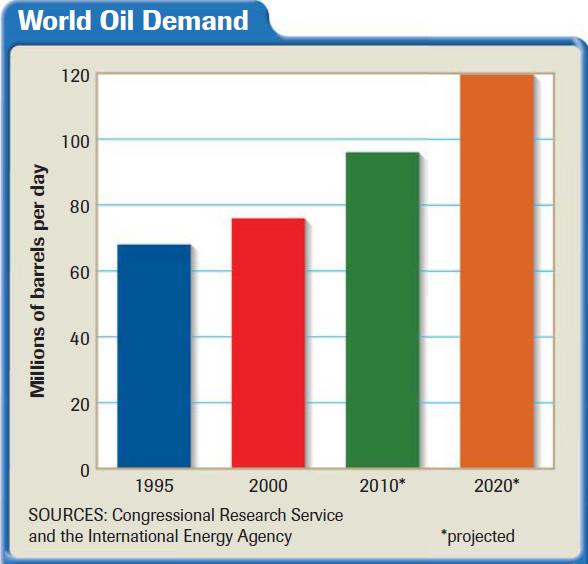
These oil reserves oasis't e'er been of great benefit. One problem is that the world's oil prices rise and autumn unpredictably. Every bit a result, Southwest Asian countries cannot e'er plan how much revenue oil will bring in. Unpredictable oil prices have also made it difficult for the region's nations to take steady economic growth. For instance, when oil prices were low in 1996 and 1997, Southwest asia's economies grew slowly. Because of that experience, the nations of that region realized that they could non continue to base their economies only on oil.
Using Oil Wealth to Diversify
To promote more than economic growth, the oil-rich nations of Southwest Asia face iii challenges in the way that they use oil profits. First, each has to modernize its infrastructure. Second, each has to develop its agricultural, mineral, and water resources. Finally, the people of each nation take to proceeds access to higher education and chore training.
MODERNIZING THE INFRASTRUCTURE
The region has improved its infrastructure. Saudi arabia, for case, has congenital new roads in rural areas, irrigation networks, and facilities to store agronomical products. It has likewise congenital desalinization plants that remove the salt from seawater and provide water for cities and industrial apply.
Other nations have constructed airports, shopping malls, and port facilities. These efforts are not always well coordinated, though. Some years ago, the UAE built four international airports to serve an expanse near the size of the state of Maine. Needless to say, these airports are greatly underused.
Toward the finish of the 20th century, nations in the region began putting together information technology systems to serve businesses. Dubai launched a plan in 2000 called Internet City. The plan made it possible for its regime to behave concern on-line.
DEVELOPING Resource
To create a diversified economy, nations of the area have to develop resources besides oil. 1 of the greatest needs is to develop agriculture. The region's arid conditions mean that the surface area is non able to produce great quantities of nutrient. To trap much-needed water for agricultural production, governments have built dams. They have also dug deep wells to tap the h2o trapped in huge underground reservoirs.
Saudi arabia tin can boast several economic success stories. By 1985, improvements in agriculture immune the Saudis to completely meet the nation'south demand for dairy products, blood-red meat, poultry, and eggs. The biggest Saudi success story, however, was wheat production.
The Saudis were determined to reduce their dependence on imported wheat. They improved water supplies so that grain production could exist expanded. By 1992, they were producing more than iv million tons of grain per year. This was enough to actually run into their needs and to have wheat to export. This diversification of the Saudi economy would non have happened without significant investment in infrastructure. That investment, in turn, was fabricated possible by oil profits.
Other nations are making efforts to develop other mineral resources. Oman revived its copper industry and chromium mines. Chromium is used in steel production for jet aircraft. Expanding these industries allowed the Omani economic system to reduce its dependence on oil profits.
Homo RESOURCES
People are a valuable resource in whatever nation. Southwest Asian nations are developing their homo resources—the skills and talents of their people.
Many of those nations also realize that they must invest in all their people, including women. Providing education and technology training is disquisitional. Nations are expanding the opportunities for their citizens to gain an education. For instance, Kuwait has established complimentary education for all children through the university level. For students who wish to study outside the state, the regime pays the fees and provides money to cover living expenses.
Many societies in Southwest Asia have strict rules concerning women's roles in society. Often it is difficult for women to get an education and detect employment. However, the shortage of workers in the region has opened economic opportunities for women. Important economical and political changes are taking identify in Southwest Asia.
As the nations work to develop their physical and human resources, opportunities for all who alive in that location volition expand. A successful economy is built on the efforts of all its people working together toward the goal of diversification.

Oil Reserves In Southwest Asia,
Source: https://geography.name/southwest-asia-oil-wealth-fuels-change/
Posted by: burrowslifeatchas.blogspot.com
0 Response to "Oil Reserves In Southwest Asia"
Post a Comment